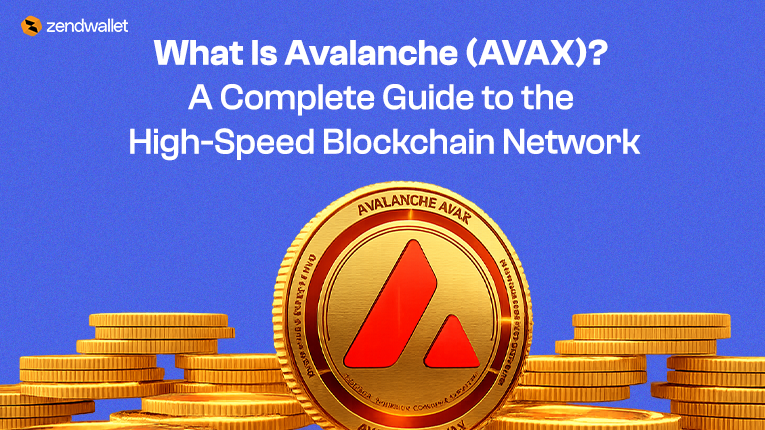
What Is Avalanche (AVAX)? Avalanche (AVAX) is a high-performance Layer 1 blockchain designed for speed, scalability, and flexibility.
Built to support decentralized applications (dApps), enterprise blockchain solutions, and custom blockchain networks, Avalanche has become one of the leading smart contract platforms in the Web3 ecosystem.
Since launching its mainnet in 2020, Avalanche (AVAX) has gained recognition for its near-instant transaction finality, modular blockchain architecture, and Ethereum compatibility.
This guide explains what Avalanche is, how it works, what makes AVAX valuable, and how to create an Avalanche wallet on ZendWallet.
What Is Avalanche (AVAX)?
Avalanche (AVAX) is a modular smart contract platform that allows developers to build decentralized applications and launch custom Layer 1 blockchains within its ecosystem.
Unlike traditional blockchains that rely on a single chain to process transactions, Avalanche separates functions across multiple specialized chains.
This design improves throughput, reduces congestion, and enhances scalability.
Key features of Avalanche include:
• Sub-second transaction finality
• High throughput
• Customizable blockchain infrastructure
• Ethereum Virtual Machine compatibility
• Interoperability across its ecosystem
The network’s native token, AVAX, powers transactions, staking, governance, and resource allocation.
Top Read: How Blockchain Technology Works: A Step-by-Step Guide
Who Created Avalanche?
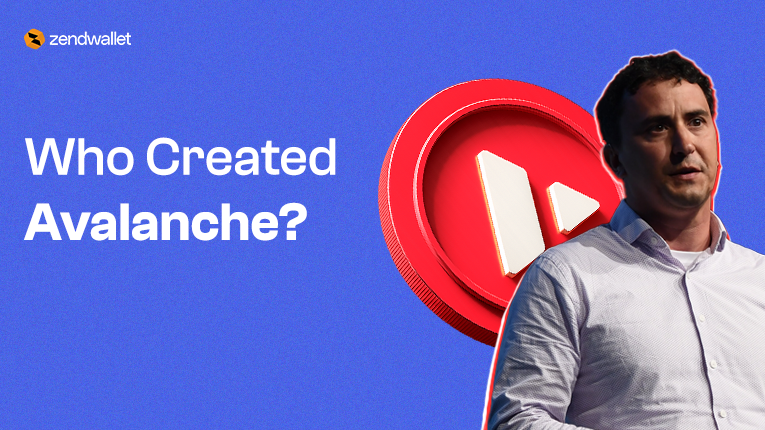
Avalanche (AVAX) was developed by Ava Labs, founded in 2019 by:
• Emin Gün Sirer
• Kevin Sekniqi
• Maofan “Ted” Yin
The protocol’s origin traces back to a 2018 research paper published by a pseudonymous group called Team Rocket, which introduced Avalanche’s innovative consensus mechanism.
The Avalanche mainnet officially launched in 2020.
How Does Avalanche Work?
Avalanche (AVAX) stands out through its consensus mechanism and multi-chain architecture.
Avalanche Consensus Mechanism
Avalanche uses a Proof-of-Stake model powered by the Snow family of consensus protocols.
Instead of depending on a fixed validator group to approve transactions, validators repeatedly sample random peers in the network to reach agreement. This probabilistic method allows Avalanche to achieve:
• Very fast transaction confirmation
• High scalability
• Strong decentralization
• Energy efficiency
Transaction finality often occurs within 1 second.
Avalanche’s Three-Chain Architecture
One of Avalanche’s most distinctive innovations is its three-chain architecture. Instead of running all network activity on a single blockchain, Avalanche (AVAX) separates core functions across three specialized chains. This design improves efficiency, reduces congestion, and increases scalability across the ecosystem.
Each chain plays an important role in maintaining performance and flexibility.
X-Chain (Exchange Chain)
The X-Chain is responsible for creating and transferring digital assets, including the AVAX token and other tokens built on Avalanche (AVAX).
Unlike traditional blockchains that rely strictly on a linear block structure, the X-Chain uses a Directed Acyclic Graph (DAG) model. This structure allows transactions to be processed in parallel rather than sequentially, which increases throughput and network efficiency.
The X-Chain is optimized for:
• Fast asset transfers
• Low transaction costs
• High throughput
• Token issuance and management
This makes it especially important for payments, asset creation, and digital token distribution within the Avalanche ecosystem.
C-Chain (Contract Chain)
The C-Chain is where smart contracts are deployed and executed. It is fully compatible with the Ethereum Virtual Machine (EVM), allowing developers to build using Solidity, the same programming language used on Ethereum.
This compatibility is important because it enables developers to migrate or deploy Ethereum-based applications onto Avalanche (AVAX) with minimal changes.
The C-Chain supports:
• Decentralized finance applications
• NFT marketplaces
• Gaming ecosystems
• Tokenized real-world assets
• Enterprise smart contracts
Its EVM compatibility and faster finality make it an important layer for scalable Web3 development.
P-Chain (Platform Chain)
The P-Chain manages validators and coordinates the creation of custom Layer 1 blockchains within Avalanche (AVAX).
It handles:
• Validator registration
• Staking management
• Governance coordination
• Custom chain deployment
Validators stake AVAX on the P-Chain to participate in securing the network. The P-Chain plays an important role in maintaining the network’s economic security and enabling expansion through custom chains.
By separating validator coordination from smart contract execution, Avalanche (AVAX) enhances efficiency and reduces bottlenecks.
Avalanche Custom Chains
Beyond its three core chains, Avalanche allows developers to create independent Layer 1 blockchains within its ecosystem.
These custom chains can define their own:
• Fee structures
• Virtual machine environments
• Governance frameworks
• Validator requirements
• Permission models
This flexibility is important for developers and enterprises that require specialized blockchain environments.
For example, financial institutions may need specific compliance structures, while gaming platforms may prioritize speed and user scalability.
Each custom chain processes its own transactions independently. This horizontal scaling model is important because it allows the network to grow without overloading a single chain.
As demand increases, additional chains can be added, maintaining performance and stability across the ecosystem.
Why This Architecture Is Important
Traditional blockchains often process all activity on one chain, which can create congestion during periods of high demand.
Avalanche’s modular structure distributes workload across multiple specialized chains and independent Layer 1 networks. This is important because it enables:
• Greater scalability
• Faster transaction confirmation
• Reduced congestion
• Increased flexibility for developers
• Improved overall user experience
By combining interoperability with customization, Avalanche (AVAX) provides infrastructure designed to support growing Web3 ecosystems while maintaining strong performance standards.
What Is the AVAX Token?
AVAX is the native cryptocurrency of Avalanche and supports the network in multiple ways:
Transaction Fees
AVAX is used to pay for transactions and smart contract execution.
Staking
Validators stake AVAX to secure the network and earn rewards.
Governance
Token holders can vote on protocol updates and network parameters.
Fee Burning
A portion of transaction fees is burned, reducing the total supply over time.
How to Create an Avalanche Wallet on ZendWallet
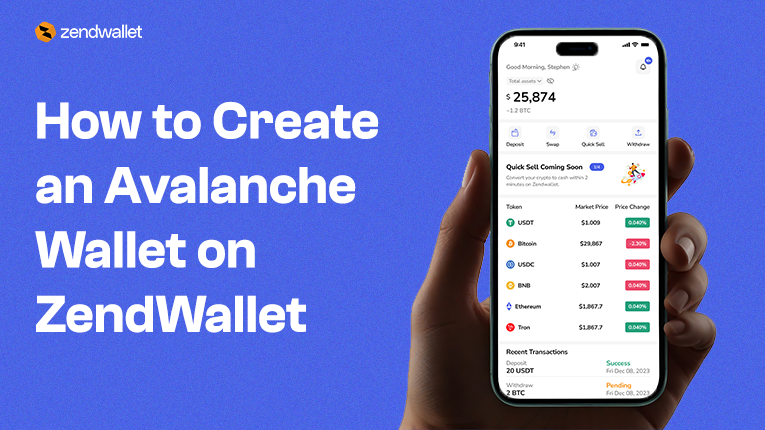
If you want to store, send, or receive AVAX securely, creating an Avalanche wallet on ZendWallet is straightforward.
Follow these steps:
- Download the ZendWallet app or visit the official platform Zendwallet.com.
- Create an account using your email and complete identity verification if required.
- Navigate to the wallet section and select “Add Asset.”
- Search for Avalanche (AVAX) and activate the wallet.
- Your AVAX wallet address will be generated instantly.
Once created, you can:
• Receive AVAX directly to your Avalanche wallet address
• Send AVAX to other wallets
• Track real-time balances
• Manage transactions securely
ZendWallet provides a secure and user-friendly environment for managing Avalanche and other digital assets, giving users full control over their crypto holdings.
Top Read: How to Buy & Create USDT TRC20 Wallet on ZendWallet
What Problems Does Avalanche (AVAX) Solve?
Avalanche was designed to address several challenges faced by earlier blockchain networks.
Scalability
Many legacy blockchains struggle with congestion during high usage. Avalanche distributes activity across multiple chains, enabling independent scaling.
Speed and Finality
Slow confirmation times affect user experience and financial efficiency. Avalanche achieves near-instant finality, making it suitable for payments, trading platforms, and real-time applications.
Customization
Developers building specialized use cases such as DeFi, gaming, or tokenization often require tailored infrastructure. Avalanche allows them to create purpose-built chains while remaining interoperable.
Cost Efficiency
Avalanche aims to keep transaction costs low. Its recent upgrades have further optimized deployment costs for developers launching custom networks.
How Is Avalanche Different From Other Blockchains?
Avalanche competes with major smart contract platforms such as Ethereum, Solana, Polkadot, Cosmos, and Near.
Its key differentiators include:
Modular design rather than a single monolithic chain
Sub-second transaction finality
EVM compatibility through the C-Chain
Custom Layer 1 creation within the same ecosystem
Fee-burning mechanism that reduces AVAX supply.
While platforms like Polkadot and Cosmos also support multi-chain ecosystems, Avalanche integrates interoperability directly within its primary network design.
Why Avalanche Matters in Web3
Avalanche represents a next-generation blockchain infrastructure focused on scalability, speed, and interoperability.
Its combination of:
• Sub-second finality
• Modular architecture
• Ethereum compatibility
• Custom Layer 1 deployment
makes it attractive to developers building decentralised finance platforms, gaming ecosystems, tokenised assets, and enterprise blockchain solutions.
As blockchain adoption grows, networks that support flexible scaling and seamless interoperability will become increasingly important.
Final Thoughts
Avalanche is a powerful and scalable Layer 1 blockchain built to support the evolving needs of Web3.
With its innovative consensus mechanism, three-chain architecture, and customizable network design, Avalanche offers a flexible foundation for decentralized applications and digital asset ecosystems.
The AVAX token underpins this infrastructure, enabling transactions, staking, governance, and economic security.
For users looking to engage with the Avalanche ecosystem, creating an Avalanche wallet on ZendWallet provides a simple and secure starting point.