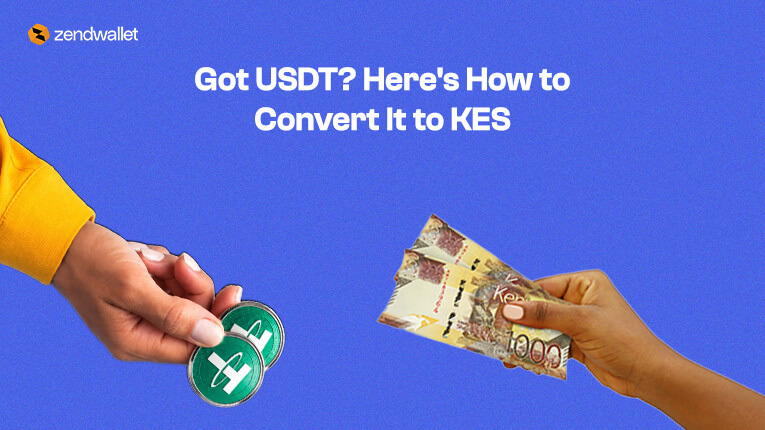
USDT in your wallet is useful, but having Kenyan Shillings in your bank account makes it even more practical.
Whether you receive USDT from an international client, trade digital assets, or hold stablecoins (USDT/USDC) in your wallet, knowing how to convert USDT to Kenyan Shillings (KES) can help you make informed decisions about your money.
In this guide, we explain what USDT is, why people in Kenya use it, how to convert USDT to Kenyan Shillings (KES), the available conversion methods, and the key steps to complete your conversion safely.
What Is USDT and How Does It Work?
USDT, also known as Tether USDT, is a stablecoin designed to maintain a value equivalent to one United States dollar.
Unlike cryptocurrencies such as Bitcoin and Ethereum, whose market prices can fluctuate significantly, USDT is designed to track the value of the US dollar. Tether states that its USDT tokens are backed by reserves and pegged at a one-to-one ratio with the US dollar (1:1).
According to Tether’s official documentation, USDT exists on several blockchain networks, including Ethereum and Tron. These networks provide the infrastructure through which users can send and receive the token.
However, USDT is not the same as holding US dollars in a bank account. It is a digital token issued by a private company, and its value, availability, and redemption are subject to market conditions and Tether’s terms.
For someone in Kenya, holding USDT may provide access to a dollar-pegged digital asset. When they need Kenyan Shillings, they can look for a service that supports exchanging USDT for KES.
Why Are People in Kenya Using USDT?
Interest in digital assets in Kenya has been examined by regulators and international financial institutions.
An IMF technical assistance report on Kenya’s crypto regulation and legislation, published in 2025, discussed findings from a survey involving 341 responses. Among the stablecoins reported as used by respondents, USDT accounted for 49%, followed by USDC at 31% and BUSD at 9%.
These figures describe the survey findings, not the percentage of all Kenyan crypto users who hold each stablecoin. Nevertheless, they provide useful evidence of USDT’s presence in the country’s digital asset environment.
There are several reasons people may hold or use USDT.
1. Receiving Payments From International Clients
Freelancers, remote workers, and digital service providers may receive payments in USDT from clients or businesses outside Kenya.
When they need to cover local expenses, ZendWallet Quick Sell makes it easier to convert their USDT or USDC into Kenyan Shillings (KES) instantly.
2. Making Cross-Border Transfers
USDT can be transferred between compatible blockchain wallets, including wallets located in different countries.
Some businesses and individuals use stablecoins (USDT/USDC) for cross-border transactions.
However, the suitability of this approach depends on the recipient, service provider, applicable regulations, and transaction costs.
Zend Business empowers businesses to make cross-border payments using stablecoins (USDT/USDC), with settlements in USD, GBP, EUR, and CAD across 140+ countries at ultra-low fees.
3. Accessing a Dollar-Pegged Digital Asset
USDT is designed to track the value of the US dollar. This makes it different from other cryptocurrencies whose prices can change considerably over short periods.
Some users therefore hold USDT as a dollar-pegged digital asset. However, the peg is not a guarantee that USDT will always trade at exactly one dollar on every platform.
4. Trading and Managing Digital Assets
People who trade cryptocurrencies may receive USDT after selling other digital assets (crypto swap).
Rather than immediately converting the balance into local currency, they may choose to hold it in their wallet until they need to access Kenyan Shillings.
How to Convert USDT to Kenyan Shillings (KES) in Kenya
Converting USDT to Kenyan Shillings starts with choosing a service that supports USDT-to-KES conversion.
You should also check its supported blockchain networks, exchange rate, and applicable fees before completing the transaction.
While the exact process may vary by provider, the following steps outline how to convert your USDT to Kenyan Shillings (KES) safely and efficiently.
Step 1: Choose a Service That Supports USDT to KES Conversion
Start by identifying a service that allows users to sell USDT and receive Kenyan Shillings.
Before choosing a provider, check:
- Whether it supports USDT deposits.
- Whether it supports KES payouts.
- Which blockchain networks it accepts.
- Its exchange rate and applicable charges.
- Its withdrawal limits and processing requirements.
- Its customer support and regulatory information.
Do not assume that a platform supporting USDT automatically supports withdrawals in Kenyan Shillings. Confirm both before funding your wallet.
For a convenient way to convert your digital assets into local currency, ZendWallet Quick Sell lets you sell supported stablecoins, including USDT and USDC, and receive Kenyan Shillings (KES) instantly.
Step 2: Check the Supported Blockchain Network
USDT exists on multiple blockchain networks. A receiving platform may support some networks but not others. For example, USDT sent through the Tron network must be sent using a compatible receiving address and network.
Before transferring your funds, confirm the network selected by the receiving service. Sending tokens through an unsupported network can result in funds being delayed or lost.
Step 3: Enter the Amount of USDT You Want to Sell
After selecting a suitable service, enter the amount of USDT you want to convert.
The platform should provide a quote showing the applicable exchange rate and the exact amount of Kenyan Shillings you will receive.
Review the quote carefully.
Check whether the displayed payout already accounts for conversion charges or whether additional fees will be deducted.
Step 4: Review the Transaction Details
Before confirming, check:
- The amount of USDT being sold.
- The exchange rate being applied.
- The platform and network fees.
- The final amount of KES you’ll receive.
- The withdrawal or payout details.
- Any applicable transaction limits.
If the quoted amount differs from your expectations, review the quote before proceeding.
Step 5: Confirm the Transaction and Receive Your KES
Once you’ve reviewed and confirmed the transaction details, follow the provider’s instructions to complete the conversion.
Depending on the service, your Kenyan Shillings may be paid directly into your bank account or supported mobile-money wallet.
Keep your transaction reference and verify that the funds have been received before considering the conversion complete.
Conclusion
Understanding how to convert USDT to Kenyan Shillings is just the first step.
There are other important factors to consider, from exchange rates and transaction times to choosing a safe way to cash out.
In the next part, we’ll explore these factors and share how ZendWallet’s Quick Sell expansion is bringing crypto-to-local-currency conversion closer to users in Kenya and about 10 African countries.