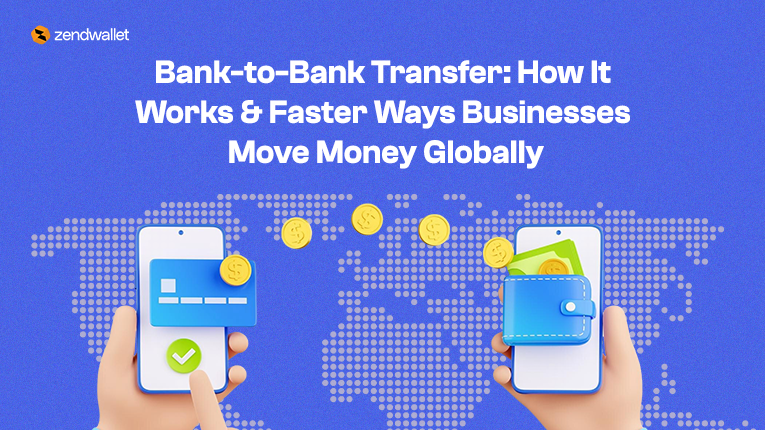
Bank-to-bank transfers have become a major part of everyday financial activity for individuals and businesses around the world.
People now use them to pay rent, send money to family, move funds between accounts, and settle international supplier payments as part of daily financial operations.
According to global financial reports, billions of dollars move through bank transfer systems every day.
In fact, cross-border payments are projected to surpass $250 trillion globally by 2027 as businesses continue expanding internationally and digital commerce grows across markets.
As financial activity increases, businesses are paying closer attention to how quickly money moves, how much transfers cost, and how easily payments can be tracked.
Simply put, the way money moves now directly influences how businesses operate.
What Is a Bank-to-Bank Transfer?
A bank-to-bank transfer is the movement of money from one financial institution to another.
Banks often refer to these as external transfers because the funds move outside their internal banking system.
These transfers can happen:
Between personal accounts
Between businesses
Across countries
Between customers and suppliers
Between different currencies
For example, a business owner in Ghana may need to send payment to a supplier in China.
In contrast, another company in Nigeria may need to pay for software subscriptions in the United States.
In both cases, bank-to-bank transfer systems enable these payments.
Today, transfers are commonly initiated through:
Mobile banking apps
Online banking platforms
Wire transfer systems
ACH payment networks
Digital wallets and payment apps
Cross-border fintech infrastructure
Top Article: How Businesses Use USDT for Cross-Border Payments?
Why Bank-to-Bank Transfers
Speed and payment visibility have become increasingly important for businesses.
For instance, imagine an importer in Nairobi ordering electronics from a supplier in Guangzhou. If payment takes 10 business days to settle, production timelines may shift, and shipping schedules may move further out.
As a result, delayed transfers can affect:
Inventory planning
Cash flow
Supplier relationships
Business operations
This explains why businesses are increasingly exploring faster payment infrastructure.
As financial analyst Thomas Brock explains, “Your choice depends on how quickly you need the money and what fees you’re willing to pay.”
Information Needed Before Sending Money
Before initiating a transfer, banks and payment providers usually require:
Recipient’s full name
Account number
Routing number or SWIFT code
Bank address
Phone number or email for some payment apps
Purpose of payment for international transfers
Moreover, businesses making international payments may also need invoices or supporting documents for compliance verification.
Therefore, confirming payment details carefully before processing any transaction is extremely important.
Top Read: https://blog.zendwallet.com/how-to-make-money-online-in-nigeria/
Common Types of Bank-to-Bank Transfers
Wire Transfers
Wire transfers are one of the fastest ways to move money between banks.
They are commonly used for:
International supplier payments
High-value transactions
Urgent business payments
For example, if a company in South Africa needs to pay a manufacturer in China immediately, a wire transfer may allow the supplier to receive funds within hours or the same business day.
However, international wire transfers often involve intermediary banks. Consequently, businesses may face:
- Additional transfer fees
- Currency conversion charges
- Longer settlement timelines
According to banking surveys, international wire transfers can cost between $25 and $50 per transaction, excluding FX charges.
ACH Transfers
ACH (Automated Clearing House) transfers move money through centralized banking networks.
They are commonly used for:
Payroll
Utility bills
Recurring payments
Personal account transfers
Unlike wire transfers, ACH payments are generally low-cost or free. However, settlement usually takes between one and three business days.
Additionally, some banks now offer same-day ACH processing for an extra fee.
Checks and Cashier’s Checks
Although digital payments continue to grow, checks still play a role in certain financial transactions.
Cashier’s checks are commonly used for:
Property purchases
Vehicle payments
Formal business transactions
Since cashier’s checks are guaranteed by the bank, they are often considered more secure for large payments.
Nevertheless, checks usually process more slowly than digital transfer systems.
Mobile Payment Apps
Mobile payment apps have changed how money moves for individuals and businesses across the world. Instead of visiting a bank branch or dealing with long transfer steps, payments now happen using simple identifiers like:
Phone numbers
Email addresses
Mobile wallets
Banking apps
Popular platforms such as Zelle, PayPal, Venmo, and Cash App have made everyday transfers faster and more accessible for personal and business use.
At the same time, cross-border payments for businesses require more than domestic transfers. This is where fintech infrastructure plays a major role in international trade and settlement.
At ZendWallet, we support businesses through ZendBusiness and Zend FX, giving them a way to manage cross-border payments, supplier settlements, and international business transactions from one place.
For example, a business in Ghana importing goods from China can fund international payments using stablecoins such as USDT or USDC, then settle in major currencies including USD, GBP, EUR, and CAD.
Moreover, Zend FX supports payments across more than 150 countries, including China, the UK, Ghana, and the United States, making it easier for businesses to operate across multiple markets without payment limitations slowing operations.
With ZendBusiness, businesses can also:
Upload invoices for verification before payment processing
Track payments across every stage of the transaction
Access MT103 receipts as official payment confirmation
Add team members and assign payment responsibilities
Request amendments to beneficiary details when corrections are needed
This level of transaction visibility gives businesses more control over how international payments move, from initiation to settlement.
As a result, businesses are better positioned to manage supplier relationships, coordinate international orders, and maintain smoother financial operations across borders.
Top Article: https://zendwallet.com/convert-tether-usdt-to-us-dollar-usd
Factors to Consider Before Choosing a Transfer Method
Speed
Some transfers need immediate settlement, especially supplier payments and urgent business transactions.
Consequently, businesses often compare payment systems based on processing time.
Cost
Transfer costs vary significantly depending on the method used.
For instance:
ACH transfers are usually free
Wire transfers often involve bank fees
Instant payment apps may charge percentage-based fees
Therefore, businesses handling large international payments usually consider both transfer speed and total cost.
Security
Security remains one of the most important parts of bank-to-bank transfers.
Businesses should use a trusted and regulated payment infrastructure with transaction tracking and verification processes.
Transfer Limits
Different payment systems support different transaction sizes.
For example, Zend FX supports transfers from USD 1,000 up to USD 1,000,000 per transaction, depending on business requirements.
International Bank-to-Bank Transfers
Cross-border transfers are more complex because they often involve:
Currency conversion
Compliance checks
Intermediary banks
SWIFT routing systems
As a result, international transfers may take several business days to settle.
However, payment infrastructure is evolving rapidly.
Moreover, stablecoins such as USDT and USDC are increasingly used for cross-border settlement because they enable faster transaction processing and easier access to global currencies.
This is becoming especially important for African businesses managing international suppliers and global operations.
Conclusion
Bank-to-bank transfers continue to evolve as global commerce becomes more digital and interconnected.
Traditional methods such as wire transfers and ACH payments remain widely used. However, businesses are increasingly adopting fintech infrastructure that supports faster settlement, transaction visibility, and broader international access.
As global business activity continues to grow, the ability to move money across banks and countries is becoming an important part of financial operations.
Our platform, ZendWallet, is helping businesses manage this process through ZendBusiness and Zend FX by combining international settlement, stablecoin funding, payment tracking, and business payment management within one platform.